 Schools
 Youtube
 Facebook

At a glance
Cow and calf production is a key livestock sector in Quebec. The quality of the livestock stands out in the markets, and the sector is consoliding.
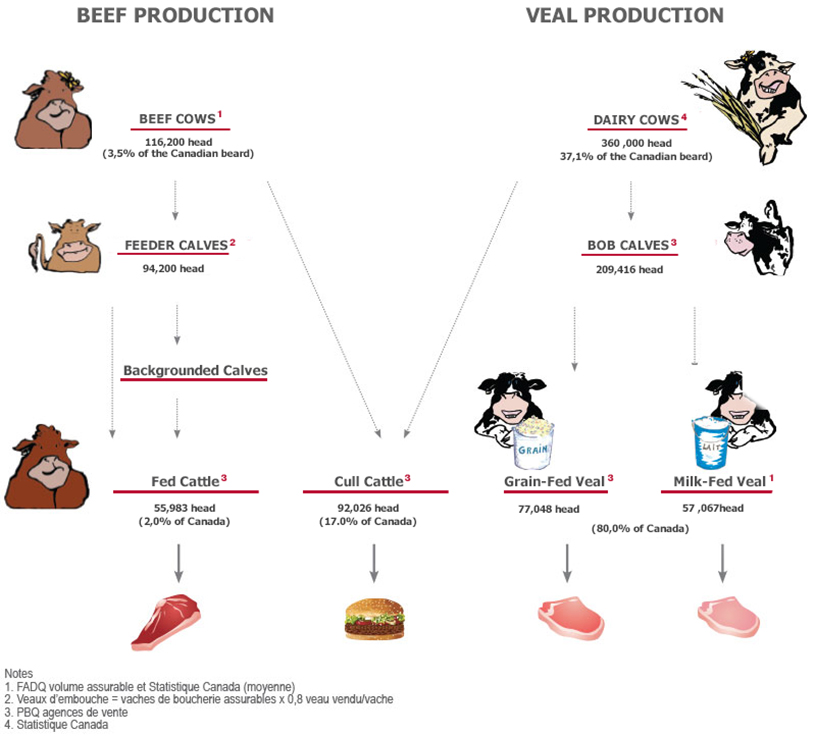
Quebec is still a modest player in the Canadian context, with cattle production (beef) accounting for around 3,5% of national production. However, the Québec veal sector is the undisputed leader in Canada, with about 80% of the country’s production. In addition, animals culled from dairy and cow-calf herds contribute to the growth in beef production (commercial beef). In this regard, Quebec produces 17% of Canada’s cull cattle.
Beef is the fourth largest livestock production type in Quebec by value, after dairy, pork, and poultry. It is among the largest job creators, accounting for the equivalent of 2,368 full-time jobs.
Quebec currently has nearly 8,000 farm operations partially or totally dedicated to cattle production. The producers are men and women with a passion for their profession. Over the years, they have developed modern livestock farming environments and rigorous quality control, which promotes on-farm food safety, animal welfare, and animal health.
The agri-environmental best practices they use also ensure cattle farms develop in a sustainable way. Producers care deeply about offering consumers nutritious, healthy meat of the highest quality!
Practiced throughout Quebec, cattle production is a key pillar of our agriculture sector as well as regional development. In 2025, over 600,000 cattle were marketed, with $1.37 billion in production value.
Two Sectors – 2025 Overview
Quebec cattle production encompasses two sectors: beef production and veal production. The beef sector includes feeder calves (beef calves), fed cattle, and cull cattle. The heavy veal sector includes grain-fed veal calves and milk-fed veal calves.
Production At a Glance
Click on a sector to learn more:
Cull Cattle and Dairy Calves
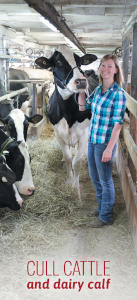
Thanks to its sizable dairy and beef sectors, Quebec is able to rely on a considerable number of cattle to be sold for meat when the time comes for them to be taken out of dairy or veal production.
Cull cattle
Cull cattle make for quality meat, chiefly in the form of ground beef, which is used in fast-food chains and other outlets. These animals generally include dairy cows, beef cows, and bulls. Cull cattle are generally sold via live auction to supply markets in Quebec, Ontario, and the United States.
The lean meat from cull cows is highly sought after. In addition, the traceability of Quebec cattle is an advantage when it comes to developing new markets.
Why do cattle get culled?
Cattle are culled mostly at the end of the productive period of their lives, whether as milk cows or beef calves. Dairy producers and beef calf producers must therefore replace their animals with new ones to meet their production targets. This is when cattle are culled, i.e., removed from the herd and the farm in order for their value to be recovered on the meat market.
After a few milk production cycles, older cows need to be replaced and are sent to the meat market. About 78,645 cows are culled each year in Quebec.
The same scenario applies in the case of beef cattle. A beef cow will give birth to a beef calf (feeder calf) and nurse it. After 7 to 15 calves, she is removed from the herd and replaced by a new gestating heifer. About 11,000 beef cows are culled in the province annually.
By making the decision to cull animals that have reached the end of their useful life and replace them with younger animals, producers are able to renew their herds. Rotating animals in this way also helps improve the genetic makeup of the herd.
Did you know?
- In Quebec, about 92,000 cull cattle (dairy and beef) produce over 60 million pounds of beef. Sales in 2024 were about $211 million.
- Quebecers consume an average of 35 lb (16 kg) of ground beef per year..
Dairy Calves
Marketed dairy calves are purchased by milk-fed veal or grain-fed veal producers for fattening. Certain calves from dairy herds are also purchased to be fattened into beef.
Why sell dairy calves?
Dairy cows must calve so they can lactate and produce milk for consumption. Dairy farmers decide on the use of the resulting calves:
- Keep them in the farm’s herd to become dairy cows when they are females considered fit for milk production;
- Market them to feedlots for fattening as veal calves for most of the males and for females unfit for milk production.
Grain-fed veal
How veal calves are raised
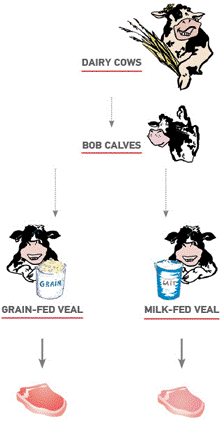
In Québec, two types of calves are destined for veal production: grain-fed calves and milk-fed calves. The distinction comes mainly from how the calves are fed, one being fed mostly grain, and the other milk.
It all begins on a dairy farm where the cow, in order to give milk, must also produce calves. After 9 months of gestation, she will give birth to a dairy calf.
The future of the young animal will depend on its sex. If it is a male dairy calf, it will be destined for veal production, while a female (heifer) will become a dairy cow.
Rearing method
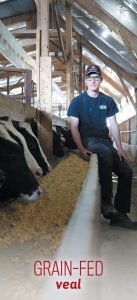
Grain-fed veal calves are raised in an environment that promotes their welfare and development. They are raised in groups and are free to move around as they wish in spacious pens. The buildings are designed to provide plenty of space and light.
As with all cattle production in the province, a traceability program is used in Quebec grain-fed veal production. This program traces the calf from its farm of origin all the way to the abattoir.
Two distinct stages characterize grain-fed veal production: a period in the nursery, followed by a fattening period, also called finishing.
Watch the video An encounter with Grain-Fed Veal producer.
Did You Know?
- Quebec has about 112 grain-fed veal farms. The farms are located in several regions of Québec, especially Montérégie and Centre-du-Québec.
- A typical specialized farm produces 824 grain-fed veal calves per year. A typical grain‑fed veal farm is a modeled reference agricultural operation whose main activity is the raising of grain‑fed calves.
- Over 77,000 grain-fed veal calves are produced yearly, with annual sales in 2025 approaching $1162,2 million (farmgate value).
- Grain-fed veal accounts for about 13% of the volume and 12% of the value of Quebec cattle production.
- Grain-fed veal producers can count on a well-established grain-fed veal slaughtering and processing industry: 98% of slaughtering and about 67% of processing takes place in Quebec.
- Employment: the veal sector generates 1,574 jobs, including 633 full-time equivalent jobs on farms. The added value to Quebec’s economy is approximately $105 million
Milk-Fed Veal
Veal production
 How veal calves are raised
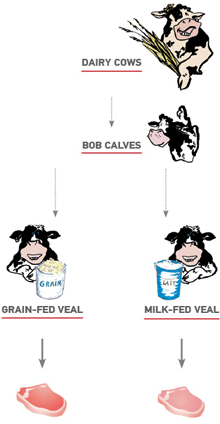
In Quebec, dairy calves are used to produce veal, either grain-fed or milk-fed. The distinction comes mainly from the animals’ diet (the former being mostly grain, the latter being milk products).
It all begins on a dairy farm where a cow, in order to give milk, must also produce calves. After nine months of gestation, she will give birth to a dairy calf.
Veal producers will mostly buy male calves for their operations, while most females (heifers) will remain in dairy herds and grow into dairy cows.
Rearing method
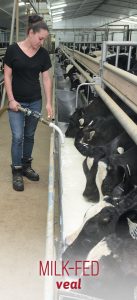
Male dairy calves, generally Holstein, are bought by veal producers who provide optimum conditions throughout the 28-week rearing period: a balanced diet, a healthy environment, and personalized care—everything needed to ensure the animals’ comfort, health, and growth!
As with all cattle production in the province, a traceability program is used in Quebec milk-fed veal production. This program traces the calf from its farm of origin all the way to the abattoir.
Did you know?
-
- There are about 31milk-fed veal farms producing approximately 57,000 milk-fed veal calves per year. The farms are mainly in the Centre-du-Québec and Montérégie regions.
- A typical specialized farm produces 941 milk‑fed calves per year. A typical milk‑fed veal farm is a modeled reference agricultural operation whose main activity is the raising of milk‑fed calves.
- The farmgate value is about $135 million.
- Milk-fed veal accounts for approximately 10% of the volume and 10% of the value of Quebec cattle production.
- It is estimated that milk-fed veal calf production generates nearly 50% of the added value downstream of production. In 2024, the value added to Quebec’s economy was $58 million.
- Employment: the veal sector generates 1,310 jobs, including 527 full-time equivalent jobs on farms. The added value to Quebec’s economy is approximately $126 million.
- Over its lifetime, a milk‑fed calf will consume approximately 280 kg of high‑quality milk powder..
Feeder Calves
Beef production
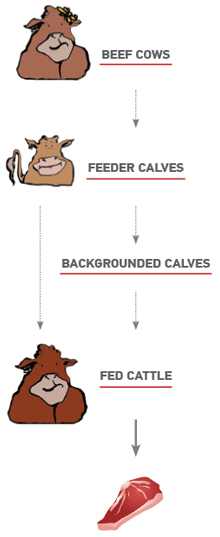
How beef is raised
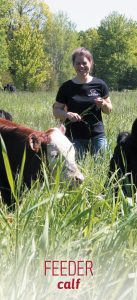
Young calves spend the first months of their lives in the pasture with their dam, a beef cow. At that stage they are called feeder calves (livestock fed on pasture). One year later, feeder calves become fed cattle.
Feeder calves come from beef-breed cattle. Unlike dairy cattle, which are raised mainly to produce milk, beef cattle are bred and fed to produce meat. Their distinguishing feature is their genetic potential to produce more muscle mass, which means more meat around the bone.
Feeder calves are generally the offspring of cross-breeding. In the first months of their lives, they graze freely on pasture and get milk from their dam.
Traditionally, calves are born between January and April and are sold in autumn. Around the age of 7 to 10 months or at a weight of 500 to 800 pounds (225 kg to 360 kg), feeder calves leave the “family nest.” A new life awaits them.
Did you know?
Before beef is served on your plate, about 18 months pass between the birth of a feeder calf and the time it arrives at the abattoir. During those 18 months, generally two, and sometimes even three, types of producers (cow-calf, occasionally backgrounding operations, and finishers) will be involved in the production process, ensuring the animals grow properly and are raised in proper conditions.
- Quebec has about 3,000 farms (cow-calf operations) scattered throughout its regions.
- A typical specialized farm has 117 cows and markets 88 calves per year. A typical feeder‑calf farm is a modeled reference agricultural operation whose main activity is the raising of feeder calves.
- Nearly 94,000 feeder calves are produced annually in Quebec, for a farmgate value of about $306 million in 2025.
Feeder calf producers are also often called cow-calf producers.
Fed Cattle
Beef production
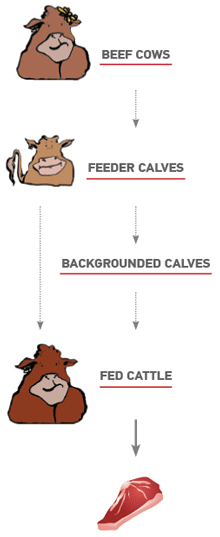
How beef is raised
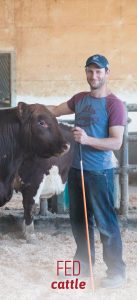
The raising of fed cattle generally begins with the arrival of a beef calf (feeder calf) at a feedlot. It is typically 7 to 10 months old and weighs 500 to 900 lb (227 to 408 kg).
Some producers specialize in the backgrounding phase, which ends at around 800 to 950 lb (364 to 430 kg). The feeder calves are ready to begin the finishing phase at this point.
The feeder calf will remain in a feedlot for 8 to 10 months, until it reaches a weight of approximately 1,475 lbs (670 kg), or 700 to 950 lb carcass weight (318 to 430 kg on a carcass basis). It is primarily fed grain corn, forage corn, minerals, and vitamins.
The cereals (corn and barley) the animals eat increase the tenderness and marbling of the meat. They have continuous access to food and fresh water.
Feed rations are balanced, high in quality, and high in energy content. The animals’ diet allows them to gain over 3 lb (1.3 kg) per day. When they reach maturity, fed cattle are sold to the abattoir, where they are processed into many different cuts of beef.
Did you know?
In Quebec, about 56,000 fed cattle are produced annually, for a farmgate value of approximately $239 million in 2025.
-
- A 1,450 lb (658 kg) steer yields an average of 850 lb (385 kg) of meat.
- Quebec has about 80 fed cattle farms located mainly in the central regions of the province.
- The typical specialized farm produces about 1,650 head of fed cattle per year. A typical specialized steer farm is a modeled reference agricultural operation whose main activity is the raising of slaughter steers.